
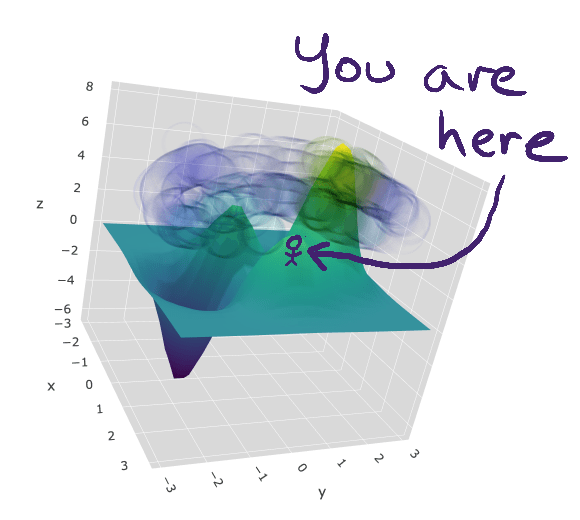
If you decided you were going to find the highest mountain in a mountain range covered in fog, how would you do it? The immediate answer that comes to mind is that you’d simply walk uphill from where you are and stop once you’re at the top. This makes sense until you realize this will only get you to the closest hill – not the highest mountain. This was a concept from an intro machine learning course – the analogy for computers being how to find the highest (or lowest) point in a function by bouncing back and forth in a ping pong like manner until it reaches its goal.
The same applies to getting better at fighting.
Popular conception of fighting ability goes something like this – the person that looks and acts the closest to the Incredible Hulk will win in a hand to hand fight. This is why the reversal in the David & Goliath story is so captivating. This is why we’ll always click to watch WorldStar videos where it’s pitched as a weak person standing up to a human mammoth, and hold out hope the smaller person turns it around. It’s simply not how fights are supposed to work.
What if I told you that there are people that I could introduce you to that are slower, weaker, smaller, and older (by enough of a margin to accurately be referred to as your “elder”) than you that can still put you to sleep with a choke, and there’d be nothing you could do about it. It’s as if your lifetime spent putting your stats in physique, stamina, and rage has been a waste of effort when it comes to saving your own life in a fight – and largely that’s true.
What does depth in this case mean? Anything that has substance beyond surface appearances or first impressions. Any activity with depth can have simple rules or steps, but can be combined in a way that leads to complexity. The limits of depth for any given activity are often hidden until someone finds them. This is why it’s hard to tell what the limits of the unknown are. Consider the high jump – the way everyone in the Olympics does it now was only first done in the 1968 Olympics, less than a lifetime ago. Now what does this have to do with fighting?
If there are people that are slower and weaker than you that can beat you in a fight, there are superior principles that rule the process of fighting above strength & stamina. If those qualities can’t help you, then there must be another way. What these older & slower folks have that you don’t have is a better understanding of what these more necessary principles are. How did they get there? How can you get there? And how can you beat them?
Experience in any field usually goes something like this – you’re given a task with a goal, and some initial guidance on how to achieve that goal. Some people help you out, you do a bit of research, maybe you’ll figure out some things on your own, and hopefully you get better without plateauing. You decide you’ll take a martial arts/boxing class, listen to your coach, do the drills, and you’ll see improvement. If you’re able to map the principles of your masters onto your own mind, you probably have a decent shot of getting as good as them. In the mountain range in the fog example, this is like running into other people on this mountain range and asking them where the highest peak is. This is a decent method at getting to a high peak. But since the mountain range is covered in fog for everyone, will it be the highest peak?

The truth in life is this – every system we have was made up by humans. Scientific discoveries that are made are reasonable best guesses for how things work. The model that works better at predicting experiments is probably scratching closer to the truth than the other guy’s model that does a worse job. It might be better, but it doesn’t mean we’ve found bedrock truth. The fog surrounds us all. Even people who have PhDs, even people who make billions of dollars per year, and even people that can kick your ass.
The solution that computer scientists have settled on for finding maximums or minimums for their foggy mountain range is by adding a part that explores. The computer is told to experiment in one way or another to see which way is higher. If you set the exploring step to be too large, you’ll take a while to find the peak if you started out close to begin with – you’ll walk right over it. If you set the exploring step to be too small, you’ll take a long time to find the optimal solution if it’s far away.
The same is true in fighting. The early UFC’s famously demonstrated that for the average person that wants to learn to defend themselves, their best bet is probably to go with Jiu Jitsu. A bunch of top talent athletes came together to see if they could prove that there are better and worse ways to conduct yourself in a fight. It turned out you didn’t have to be the best athlete nor the largest person to save yourself or dominate someone else.
For fighting, it looked like the people doing Tae Kwon Do might have set their exploring steps a little too small. Maybe they were onto something, but had too many weaknesses to be effective and got lost in their own convoluted rules. Then there were the folks who convinced themselves they were adept at no touch death arts – people who set their exploring step to be so large, they got lost in Candyland never to return, and maybe a few were lucky to leave after reality knocked their ass out.
Now, if the fog is covering the mountain for everyone, how do you find the highest peak? How do you improve at fighting to a level where you’re better than the other people that are out there? Inventiveness and exploration. Simply put, you have to have your own exploring step – something that gets you to try something new – sample the new, and see where that takes you.
Unfortunately for humanity, genuine inventiveness and discovery is rare. We seem to be a species that is much better suited at copy/pasting existing methods than for inventing new or life changing ones. Consider how many physicists have their names attached to fundamental equations vs the number of physicists. Most knowledge that’s in our brains is a set of untested or barely tested assumptions that we’ve taken into our minds. To be fair, if you had to derive on your own or cross reference everything that went into your mind before it was stored in your knowledge banks – you’d learn close to nothing. The short cuts our mind takes allow us to accumulate facts to be effective in the world. Effective enough to help us get our genes one generation further, and we’re lucky if we get more out of it than that.
What helps in discovering what can take you to the next level? Experimentation, surely, but how does somebody experiment to make themselves better? Unfortunately, there is no method for that. There is no map. Every method that has been tried has gotten us exactly where we are.
Aside from divine luck giving you a nudge towards discovering the holy grail, what can you do? Keep exploring, trying, tinkering – even when you’re the best or think you’re doing wonderfully. In the path to the highest mountain in the fog, there is always potentially a better way. Claim that your way is the best at your own peril – unless you’re right, welcome to your plateau.
Having a willingness to let go, of a position, of a method, of a choke, your strength, your speed – this can all help. Though no guarantee for discovery, valuing thinking of things as play can help give you longevity and can keep you in the game (let’s see how long you can endure this process if you feel it’s a grind vs. a place where you can play & enjoy yourself). Being able to admit that you might be wrong – these can all help put things in a new light. At the end of the day, there is no prescription for exploring new territory. It will either happen, or it will not.
As Richard Feynman put it for making discoveries in physics:
“But the new problem, where we’re stuck. We’re stuck because all of those methods don’t work. If any of those methods would have worked, we would have gone through there. So when we get stuck in a certain place, it’s a place where history will not repeat herself. And that makes it even more exciting because whatever we’re going to look at, at the method and the trick, and the way it’s going to look is going to be very different than anything that we’ve seen before because we’ve used all of the methods from before.”
If the legends of Rickson being able to submit world champions without having to resort to his attributes are true, then there is still room for discovery in Jiu Jitsu.
 The Aging Savage